Author: Bindi Stables

  • Sounds of Yoga: A Beginners Guide to Kirtan

    Sounds of Yoga: A Beginners Guide to Kirtan

    The word Yoga means ‘union’. Yoga refers to a state of Being that is one of Unity. It refers to the various practices that guide us into this blissful experience of Being in Oneness.

    The ultimate goal of yoga is to experience connection, union, oneness with our own True Self.

    You may be familiar with Yogic practices such as Poses (Asana), Meditation (Dhyana,) Breath Control (Pranayama.) These are all a part of a specific self-disciplinary path of yoga called Raja Yoga, in which one uses the breath, the body and mind to experience higher states of awareness, the state of Yoga – Absolute Unity.

    But Raja Yoga is not the only way… did you know there are actually three other traditional paths of yoga designed to guide the practitioner to the state of Yoga – or Liberation?

    These four paths of yoga are: 

    1. Karma Yoga, the path of selfless service
    2. Bhakthi Yoga, the path of love & devotion
    3. Raja Yoga, the familiar path of self-discipline
    4. Jnana Yoga, the path of wisdom or self-inquiry.

    Less known in western circles of yoga is the path of Bhakthi – the sweet path of love!

    Bhakthi Yoga is the sweet path of love and devotion. Love itself can be your yoga practice.

    That’s right… Love can actually be your practice. There are many common ways to practice this beautiful path of yoga including dance, ritual, ceremony, worship, pilgrimage, prayer, singing and more.

    Below, we’ll teach you one of our favourite practices of Bhakthi Yoga that helps guide practitioners home to their own True Self with ease, joy and of course… Love!

    WHAT IS KIRTAN?
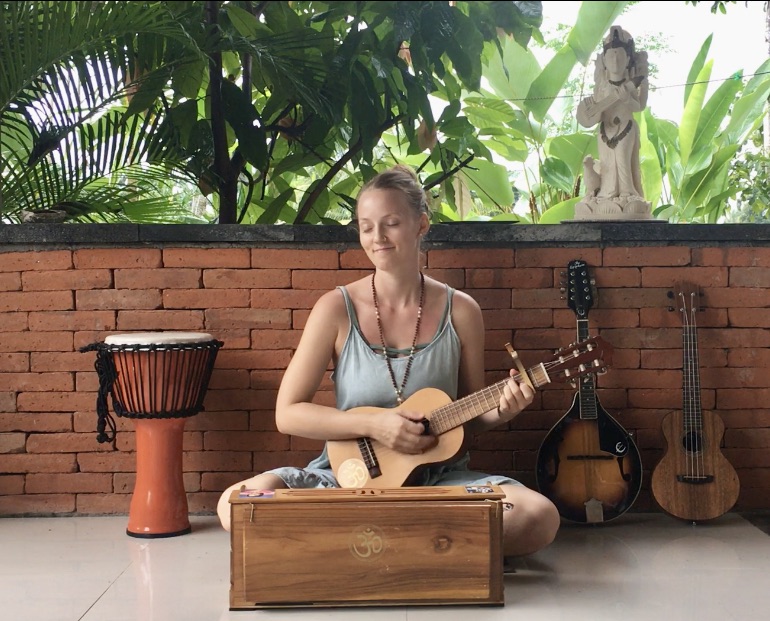
    Kirtan is a simple, yet powerful spiritual practice of Bhakthi Yoga– the yoga of the Heart. Bhakthi is the Yoga of Love and Devotion, a deeply heart-opening experience, Bhakti is the cultivation of unconditional spiritual love.

    Kirtan is considered the song of the soul. It is non-dogmatic and practiced in the Universal language of Love, through the singing of ancient Sanskrit chants, Kirtan is a powerful, effortless and joyous way to connect to your heart and meditate.

    Kirtan is a celebration of life and a worship of Love. Immersed in the sound, vibration and sensations of the sacred Sanskrit chants (Mantras), the mind becomes quiet, the soul awakens and the Heart blossoms into Pure Love.

    Kirtan is another practice of yoga which helps guide our way back home— to ourselves, to the True Essence of our Being, which is Divine Love.

    It is a highly effective spiritual practice, Sadhana, which allows us to channel all of our emotional states towards The One of which we are all apart, and to lose ourselves in this Unconditional Love that unites us all.

    “Devotional singing is the spontaneous music of the soul. Nobody can resist the inspirational qualities of such music penetrating one’s heart when it is sung with concentration and devotion. Children, sing from the depth of your hearts. Let the heart melt in prayer. The joy of singing the Lord’s name is unique. This Bhajan is for us to pour out all our hearts’ accumulated dirt. Leave aside all shyness and open your heart to God.” 
    — Amritanandamayi Devi

    WHY CHANT?

    Chanting is like yoga poses for the mind and heart.

    Much like how each Yoga Asana (pose,) has unique benefits to open and heal the body, each Sanskrit chant is infused with unique vibrations to open and heal the mind & heart.

    These ancient mantras are power medicine that heal and align us from deep within.

    Much like when a child needs to take medicine, we hide it in some kind of sweet syrup. With chanting, the music is the sweet syrup that the medicine of mantra is infused in, and the silence that follows the chant is the moment we digest the medicine and allow it to heal us.

    These ancient chants contain powerful and transformative sounds and vibrations.

    Through singing them with love, we are able to experience a super conscious state of existence— kindled by intense emotion, concentration upon the mantra and immersion into the present moment.

    AWAKENING THE GOD/GODDESS WITHIN

    The nature of our True Self is Bliss. When we call out the various names of the Godly Self that dwells within us, the mind merges into its Bliss. It loses itself in that Bliss. It becomes one with the Bliss itself.

    These simple melodies invoke a deep state of peace, harmony and tranquility inside us to that help us reconnect with who we really are. Through sacred prayers of intention, gratitude and devotion we unite with the Pure Love that resides within us all.

    These ancient Vedic chants are songs of peace and they fill our hearts with love. And when we come together with devotional music and chanting, not only are we attuning ourselves to these positive vibrations of peace and love, but we are rendering a great service to the world.

    Chanting aids in humanity worldwide in its quest for peace and unity. It is a potent remedy for healing and to reconcile the illusion of separation between us. We join together with our voices, hearts and prayers or healing, joy and peace for all beings everywhere.

    WHY PRACTICE?

    Chanting is not some obscure new age musical performance… it is a valuable tool practiced by people from all walks of life from all over the world to help heal their bodies, quiet their minds, open their hearts and invite the sacred into their lives.

    The latest discoveries in neuroscience confirm the healing power and benefits of sound, particularly of devotional music.

    Below are some benefits of chanting as indicated by both modern science and the great sages and saints of India:

    • Soothes the nerves & relieves tensions
    • Balances mind & emotions
    • Improves overall health & immune system
    • Improves concentration powers
    • Supports one’s meditation practice
    • Reduces negativity in the mind
    • Purifies the environment & surroundings
    • Guides us into contentment & contemplation
    • Purifies the Nadis & Chakras & awakens the Kundalini
    • Directs emotions towards a positive goal
    • Melts the heart & fills the mind with purity
    • Generates harmony, compassion & divine love
    • Experience God – the Love of your own Divine Nature

    “If we follow the path of devotion, we can enjoy the fruit of bliss from the very beginning, whereas with the other paths, it can be tasted only towards the end. Bhakti is like the jackfruit tree that bears fruit at its very base, while one may have to climb to the top to pluck fruit from other trees.” – Amritanandamayi Devi

    Amritanandamayi Devi

    TYPES OF PRACTICES & WHAT TO EXPECT IN A PRACTICE?

    In the Bhakthi tradition, there are many types of Sangita, or Devotional Music— most commonly known in western circles are the practices known as Kirtan and Bhajan.

    Kirtan comes from the Sanskrit root Krit, which means to ‘praise’ or ‘celebrate.’

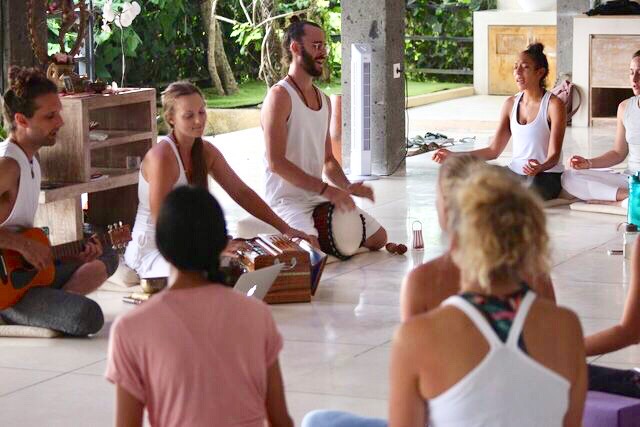
    Kirtan is a chanting practice of union through devotion that encourages the repetition of Sanskrit Mantras or Divine Names to merge into a deep meditation. It is practiced in a call & response format of which the leader, the Kirtan Wallah, calls the mantra chanted and the group responds it back. It is often experienced in a group environment and usually practiced in the ancient and holy language of Sanskrit. It is often an interactive experience of singing and can be very powerful, fun and ecstatic!

    Alternatively, Bhajan, which comes from the root word Bhaj, mean ‘sharing.’

    Bhajan is usually practiced as communal singing in a sing-a-long format. It may be experienced in a group or alone and refers to devotional songs in prayer and hymns to the divine (rather than the repetition of God’s name.) It is often more free form and less structured than a Kirtan and can be practiced in many languages.

    Both practices are not so much of a performance or concert, but rather a journey into the Self through deep listening and chanting the various names and aspects of our own Divine Nature.

    The main elements of both Kirtan and Bhajan are mantra, music and meditation— but the secret ingredient to a very a powerful practice is your own Bhakthi, love and devotion.

    Immersed in the sound, vibrations and sensations of the sacred sounds of the mantras, the mind becomes absorbed into and entrained by these vibrations, and at the end of the chant, there is a blissful silence or meditation to feel and experience the profound benefits of chanting, in which the mind becomes deeply still.
    kirtan

    HOW TO PARTICIPATE?

    Chanting is universal—you do not require any previous experience, you don’t need to know the chants ahead of time, you don’t need to be a good singer or feel coordinated with following a rhythm. More important than how it sounds, is how it feels. More valuable than knowing exactly the chants is your love and devotion when you sing them. More important that understanding the meaning of the chants or the practice, is your own Direct Experience.

    Bhakthi Yoga isn’t really something you doBhakthi is love. So practicing Bhakthi Yoga is like falling in love. And this love that we may experience isn’t new— it isn’t something you attain or achieve or become— because you are already that. But rather, it’s something you remember, something you reconnect to and stoke from deep within.

    This love is the love of the Inner Self, which through practice, we can learn to see ourselves reflected in the eyes of all beings we encounter. This is true unconditional spiritual love.

    ”One can realize God through Kirtan alone. Kirtan is singing of God’s name, with feeling. If one does Sankirtan from the bottom of one’s heart, with full bhava (devotion) and prem (love) even the trees, birds and animals will respond. They will be deeply influenced. Such is the power of Sankirtan. It brings the devotee face to face with God. The chanting of Sanskrit Kirtan, even when mechanically done, produces certain effects. When done with devotion, and awareness of the meaning, its benefits are immeasurable.” 
    – Swami Sivananda

    TIPS FOR PRACTICE

    What one puts into their practice, is what they can receive from it.

    To the degree of which one may be present, open and expressive is to the degree of which one may experience the profound nature of this practice. This is your practice, so really— anything goes. There is truly no right or wrong way to experiencing this practice!

    However, if you’re new to the practice, here is some insight into how you may choose to express yourself through the practice:

    • Sing: Singing is the heart of Kirtan. It’s not about how well you sing or how musical you are, but about how it feels. As long as your practicing with an open-heart, you’re doing it right.

    • Clap or Dance: Allow the chants to move through you and within you. You may feel inspired to clap along to the beat, tap along in your seat or get up and dance! Any physical expression of love & devotion that moves through you goes here.

    • Listen & Receive: In call and response Kirtan, hearing the names of the Divine is equally important as calling it out. When you hear the chant, hear that Divinity residing in your soul and when you call it out, feel that Divinity being expressed.
    • Meditate: Whether your singing aloud, or chanting silently in your own mind, chanting can evoke a deep sense of meditation within. During a practice you’re welcome to close your eyes and meditate – feeling the divine vibrations of sound dancing within and around you.
    • Lose Yourself in Love: Allow the magic and mystery of the chants to carry you within – to your Self, to your Source, to the Universal Love that is your True Nature.
    • Begin & end in blissful silence. Silence is the blank canvas from which the sound of music is painted upon. Beginning and ending in silence gives us a chance to deeply appreciate and experience the art of chanting

    “To gain concentration in this age of materialism, bhajan is easier than meditation. By loud singing, other distracting sounds will be overcome and concentration will be achieved. Bhajan, concentration and meditation, this is the progression. In fact, constant remembrance of God is meditation. Bhajans sung with one-pointedness, will benefit the singer, the listener and also Mother Nature. Such songs will awaken the listeners’ minds.”– Amritananda Mayi Devi

    May we all fill our Hearts with Infinite and Eternal Love as the magic of Kirtan carries us within– to our own Self, to our Source, to the Universal Love that is our True Nature and that which unites us All as One.
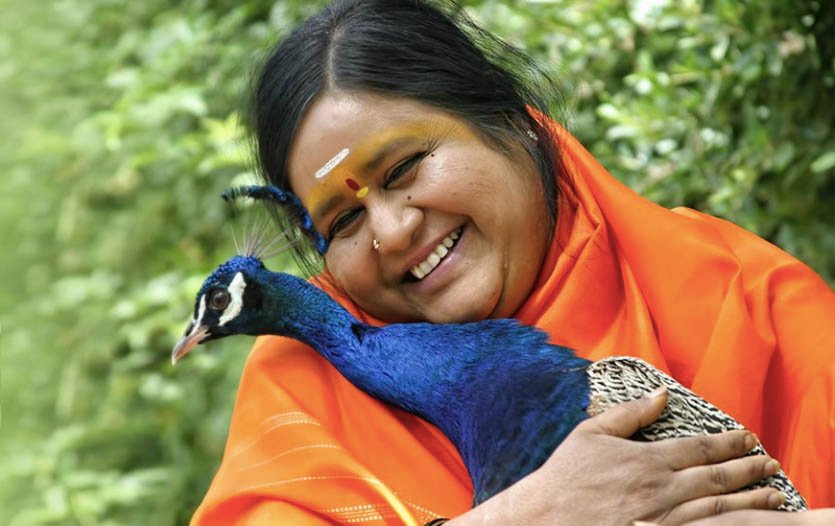

  • The Embodiment of Divine Motherly Love: The Life & Teachings of Amma Sri Karunamayi

    The Embodiment of Divine Motherly Love: The Life & Teachings of Amma Sri Karunamayi

    Amma Sri Karunamayi, also affectionately known as “Amma” which means “Mother”, is revered as an embodiment of unconditional Divine Motherly Love and Wisdom.

    A living saint, humanitarian, peace leader & spiritual teacher worldwide, with Her outpouring compassion, unconditional love and grace on all beings and sharing the sacred knowledge of the Supreme Self called Sri Vidya, and helping all beings everywhere to live in peace and happiness is Amma’s mission.

    “The nature of the Supreme Self is cosmic love only.”

    Amma Sri Karunamayi

    A GODDESS WAS BORN

    Amma’s birth was extraordinary. Prophesized by great sages such as Bhagavan Sri Ramana Maharshi, it was predicted that Her parents would birth into the world an embodiment of supreme love and knowledge in the form of Divine Mother.

    Amma’s parents received many powerful signs and visions indicating that their daughter would be Divine…

    “One such incident occurred when Amma’s father went to the Chamundi Temple in Mysore, India to study Vedic scriptures. While studying, a little girl grabbed his books and prayer beads and went off running with them. Amma’s father did his best to find the girl, but mysteriously had great difficulties. Finally, he was led to a very sacred and holy place in the temple where he caught the girl, and holding Her in his hands inquired as to why She had stolen the mala and books…

    The little girl laughed and instantly disappeared in thin air leaving below Her two footprints drawn on the floor.

    One made with holy turmeric powder and the other with holy kumkum (red vermillion) powder, and both having a perfectly drawn Shri Yantra (the highest symbol of Divine Mother as the Matrix and Creatrix of the universe) placed inside them.”

    Shortly after this incident both of Amma’s parents made a pilgrimage to the Chamundi Temple and witnessed a Divine light emanate from the inner sanctum of this Divine Mother temple and enter the womb of Amma’s mother.

    In 1958, in the southern Indian state of Andhra Pradesh, Shri Karunamayi, was born on Vijayadashami, the most auspicious day of the year symbolizing Divine Mother’s victory over the ego or ignorance. For this reason, Amma is also known as Bhagavati Sri Vijayeswari Devi, “The Victorious Goddess”.

    HER DIVINE EARLY LIFE

    As she grew into a young woman, Amma felt an inner urge to begin spending more and more time in her family worship room, immersed in prayer and meditation. As her meditations deepened and intensified, she also began reducing her intake of food. These meditation sessions grew in length until one day Amma locked herself inside a room of the house and remained there in meditation for a month.

    Though her family members were perplexed, they did not dare to disturb her, having witnessed the profundity of her meditations before. When she finally emerged, she seemed like a different person to her family members. Though she still showed the same sweet affection to which they were accustomed, her demeanor now expressed a more impersonal, universal love.

    “The only real wealth is peace”

    Amma Sri Karunamayi

    AMMAS LEAVES TO THE SACRED FOREST

    Determined to fulfill the sacred purpose of her life, Amma gently told her mother that it was time for her to go into seclusion in the sacred Penusila Forest, to meditate there in solitude. Always respectful of her daughter’s divine nature, and trusting completely in God, Amma’s mother did not try to stop her from going.

    In the year 1980, at the tender age of 21, Amma left the comfort and security of her parents’ home and traveled by foot to the remote and sacred Penusila Forest, where a number of India’s ancient sages had meditated for many hundreds of years.

    There, she lived an austere life absorbed in meditation for hours, days, or even weeks at a time with the intent of fulfilling the sacred purpose of Her life— to uplift humanity and bring peace to the world.

    EMERGING FROM THE FOREST

    After performing such intense practices for over 10 years, Amma decided that it was time to share her knowledge with all those who thirsted for true spirituality, wherever they may live in the world.

    An ashram and Divine Mother temple (Devi Mandir) was later built in Penusila, in the same area where Amma had spent her many years of spiritual practices where true spiritual seekers from around the world come for deep yogic and meditative practices.

    “True happiness and contentment come only when we serve others, love others and trust others based on mutual understanding.”

    Amma Sri Karunamayi

    AMMA TODAY

    Amma continues to serve the world in the highest way through inspiring and guiding countless projects aiming to alleviate suffering, healing and uplifting humanity. With numerous projects aimed in:

    • The eradication of poverty
    • Free medical care for the disadvantaged
    • Free housing to those in need
    • Stopping child labor through free schooling & mentoring programs
    • Supplying water treatment facilities to those in impoverished communities
    • Educating & empowering the next generation with Knowledge

    Read more about Ammas charities or how to get involved.

    Amma works selflessly and tirelessly to help all beings through Her charitable projects, Her Timeless Teachings, and Her Divine Love.

    “Let your heart constantly overflow with waves of compassion. Give your love to those who are alone or in a helpless state.”

    Amma Sri Karunamayi

    MEETING A LIVING SAINT: BE WITH AMMA YOURSELF

    Amma now offers yearly public programs around the world where she offers teachings, blessings, meditation retreats, sacred ceremonies for the benefit of all beings and so much more.

    She comforts every follower with Divine Motherly Love. Amma often likes to say that Her only work in this world is to remove the suffering from the hearts of Her children. This she does through Her kind, loving words of spiritual guidance and encouragement, Her healing touch, and Her divine knowledge and insight.

    Today, Amma divides Her time between the US, Canada, Europe, Asia, Australia and India, fulfilling Her life’s mission of providing comfort, solace, and spiritual guidance to all who come to Her.

    Read more about Amma’s world tour and to find Her at a city near you here.

    To join one of Amma’s programs at Her ashram in India, click here.

    “Knowledge of the Self, compassion, equanimity, pure devotion, inner faith and complete divine love— these are the qualities that illuminate the heart.”

    Amma Sri Karunamayi

    OUR ENDLESS LOVE & GRATITUDE TO OUR BELOVED AMMA

    With annual pilgrimages in India to her remote forest ashram and temples and trips to North America to be with Amma, plus an undeniable inner connection, it is our great fortune to have Her Holiness, our beloved Amma as our Great Teacher, Satguru and Spiritual Mother.

    We are endlessly grateful for her endless compassion, love, teachings, blessings, wisdom and grace in our lives and for the the benefit of the whole world.

  • Secrets of Vrksasana: The Untold Tales of Tree Pose

    Secrets of Vrksasana: The Untold Tales of Tree Pose

    If you’ve practiced yoga before, it’s likely you’ve encountered a beautiful and ancient posture called Tree Pose, or Vrksasana, in Sanskrit.

    Its beautiful shape is inspired by the elements of a tree— the toes spread wide resembling roots connecting down into the earth. The standing leg strong, sturdy, stable like the trunk of the tree. The torso long and tall, arms like branches growing towards the sun with fingers spread wide open like leaves extending into a heavenly sky above.

    Naturally, this pose awakens a deep sense of connection to the earth and leaves us feeling grounded, centred, connected, focused and present like a tree.

    But there’s more to Vrksasana than just a pretty, feel-good pose— this configuration is encoded with symbolism, ancient wisdom and deep spiritual meaning.

    Here you’ll discover the deeper meaning behind tree pose, the beautiful yogic connection to trees and the secret powers of this posture so you can take your yoga practice to new heights.

    Vrksa (vrik-SHAW) = tree
    Asana (AHH-suh-nuh) = posture

    THE YOGIC ROOTS & CONNECTION WITH TREES

    In spiritual traditions around the world, trees play an interesting role in the world of spirituality. Trees have been revered as sacred by many cultures, both ancient and modern. Appearing throughout most ancient Indian literature, trees are sacred— symbols of life and expressions of the Divine.

    PLACE OF ENLIGHTENMENT

    In many wisdom traditions, enlightenment occurs under the shelter of a tree— from the famous example of Buddha and the Bodhi to countless saints and sages that have entered a profound state of bliss under a holy tree.

    TREES AS A DIVINE MOTHER

    In Yogic traditions, Mother Earth has been deified as Bhumi Devi, or the Goddess of the Earth.

    Trees are personified as Divine Mother, with a selfless maternal nature of giving to humanity— the shade and shelter She provides, the oxygen from Her leaves, the wood gives fuel for burning and building, Her fruits provides nourishment to all of Her creatures, Her roots give stability to the earth, uphold the ecosystem and filter the soil. Every part of her is an Ayurvedic or natural medicine— her leaves, fruit, bark, roots, flowers and seeds.

    As we cut a tree down to make use of her wood, the mother tree selflessly offers herself without complaint. Her love is so great, that if you cut a branch, she will respond by growing more fruit.

    TREES AS GODS & GODDESSES

    Vedic cultures revere trees as sacred— it is said that all trees are embodiments of innumerable Gods and Goddesses.

    Worship of trees is a common way to honor the God or Goddess that dwells within that tree. During certain Vedic rituals, the roots, fruits, or flowers of the trees are offered back to the respective God or Goddess associated with that tree as a humble offering of love.

    For example, Lord Shiva is known to reside within the sacred Bilva Tree, commonly known as the Bael or Bel Fruit Tree. These leaves are auspiciously offered during ceremonies pertaining to Shiva energy. The well-known trees through Ayurveda, such as the neem tree and Tulsi tree (Holy Basil,) are worshipped as a form of Lakshmi Devi— the Goddess of abundance.

    VEDIC TALES OF THE TREES

    Vrksasana is one of the most ancient and important yoga poses known to humanity and is found in most systems of traditional yoga.

    Throughout classical yogic texts, there are countless examples of yogis, saints, sages, gods and goddesses relying upon trees or practicing Vrksasana to acquire knowledge perform heroic acts, gain strength and invincibility or even receive boons from God.

    • The great Ramayana text expresses the Goddess Sitas’ affinity with the forest. Sita sees only the beauty and giving nature of forest… the forest is all-giving, nourishing and all-embracing.
    • In the classical story of the Mahabharata, Pandu practiced tree pose to win the grace of Lord Indra so that his wife could give birth to the greatest warrior of the named Arjuna.
    • The tree mother came to earth during the great churning of the oceans along with Mother Cow and Lakshmi Devi in the form of the “wish fulfilling tree” known as the Kalpavrksa.
    • There’s a story of a great sage Bhagiratha who practiced tree pose for 300 years on one toe to so that the God of Creation, Brahma, God of Preservation, Vishnu, and God of Dissolution, Shiva, would bring the River Goddess, Ganga Devi from the heavens to the earth so her sacred waters could liberate him and his ancestors. (Before this holy river was on earth!)
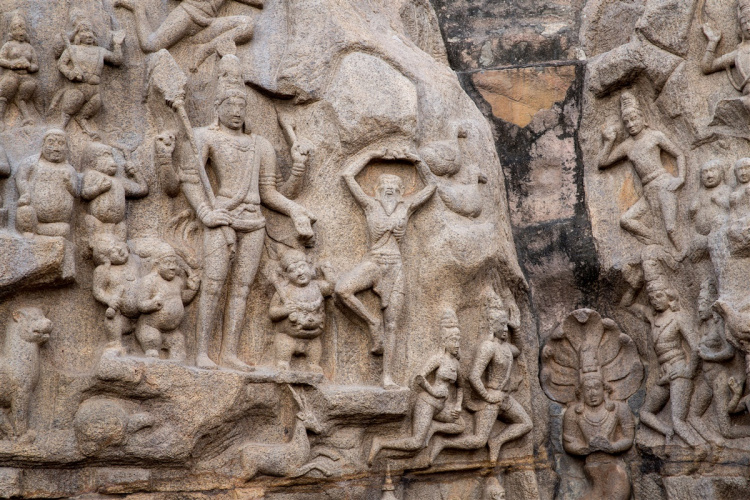
    Ancient monument “Descent of the Ganges” at Mamallapuram in Tamil Nadu, India

    7 SUPER POWERS OF VRKSASANA

    Vrksasana is a very significant and common pose in most classical yogic literature. Below are some ancient secrets as to why yogis have loved this pose since time immemorial!

    1. Mantra Amplifier— reciting a mantra on one leg in tree pose is known to be significantly more powerful and gives more merit (punya) than regular mantra practice.

      In temples in India, wise ones know this secret and will often recite mantras and prayers in front of a deity in tree pose to acquire boons from God.
    2. Wish-fulfiller— a great yogic secret is that the Sanskrit word for tree, also means “wish”, Vrksasana is a great pose for generating austerity (tapas) to manifest our noble desires.

      Trees are considered spiritual by nature, and wish-fulfilling because every part of Her is an offering for humanity.
    3. Enhances one’s meditation— the strength developed in the big toe by practicing this pose results in a firmly balanced mind which give the ability to sit longer in meditation.
    4. A teacher in loveVrksasana is a great teacher, like a mothers’ selfless love giving for her children, this pose inspires us to love and serve like the blessed mother tree.
    5. Cultivate forbearance, patience, tolerance, forgiveness— just like a selfless, generous, grounded mother tree.
    6. Stimulates the Root Chakra (Mooladhara Chakra)— strengthening our connection to the earth, stability, security, faith and trust in life.
    7. Develops intense concentration and willpower— To this day, great yogis, Sadhus of India are found to practice Vrksasana from 4 hours to 12 years for special spiritual practices— they’ll even tie themselves up to trees to be able to hold this position as long as possible to receive the great gifts of this pose.
  • Cooking as a Spiritual Practice: A Yogis Guide to Vedic Cooking

    Cooking as a Spiritual Practice: A Yogis Guide to Vedic Cooking

    Food and diet play an essential role in the life of all spiritual seekers.

    Yogic cooking, also known as Vedic cooking, reveals to us how we can transform the act of cooking into a divine ritual, the secrets and alchemical yogic practice of transforming food into medicine, and how to prepare food as a sacred service— an offering of love and healing to ourselves, our loved ones and the world.

    In this article, you’ll discover the essence of Vedic cooking, 3 essential practices of Vedic cooking, plus sacred mantras and everyday rituals to transform your kitchen into a temple and your food into nectar for greater health, vitality and spiritual remembrance.

    “Food is not only essential for survival.
    It is part of the sacred awakening of consciousness.”

    – Amma Sri Karunamayi

    THE ESSENCE OF VEDIC COOKING

    The ancient texts reveal to us that not only is what we eat, but how we eat important. And not only how we eat, but how we prepare the food essential in nourishing our bodies, minds and spirits.

    Vedic cooking is a spiritual approach to cooking that views both food and cooking as a medium for sacred transformation— a way to elevate both health and consciousness. Cooking is seen as a humble and selfless service— a contribution to the peace and healing of ourselves, our loved ones and the world.

    Food is medicine and diet is a pathway to balance, vitality and longevity— essential for a yogi to pursue their spiritual practices for the noble purpose of spiritual realization.

    3 ESSENTIALS TO VEDIC COOKING

    To prepare food in a sacred way, we need three things— clean kitchen, clean hands, clean mind.

    1. CLEAN KITCHEN

    Yogis transform their kitchen into a temple— a sacred space to nourish the divine within us, and in those we love.

    It should be well organized, uncluttered, free from dirt and distractions.

    Our cookware, utensils, dishes, dishcloths also must be absolutely clean and reserved for Sattvic, vegetarian service.

    You may wish to dedicate a space in your kitchen for a small altar to transform your cooking into a meditative practice or devotional offering of love and nourishment. Here you can include an image or statue (murthi) representing your own unique understanding of the divine, light a candle or oil lamp, and perhaps offer some incense to your altar to sanctify the space and nourish love before you cook.

    “Cooking is a spiritual practice.”

    – Amma Sri Karunamayi

    2. CLEAN HANDS

    Our hands represent our actions or karma. We wash our hands thoroughly, tie back our hair when we enter the kitchen to handle food. Ideally, we are freshly bathed in clean clothing.

    Clean hands isn’t just referring to physical hygiene— but mental and energetic hygiene also.

    Vedic cooking inspires us to set aside all other worldly actions, preoccupations, and distractions for the time being, and dedicate ourselves wholeheartedly to the present act of cooking.

    If we are interrupted during food preparation, we rewash our hands and reset our attention before continuing.

    3. CLEAN MIND

    A clean mind refers to our sacred intention and full, one-pointed awareness. Our hearts and minds should remain fully focused.

    One of the main features of Vedic cooking, is the understanding that thoughts are energy, and energy is not separate from matter— therefore thought-forms energetically influence the foods we eat.

    Most of our food is exposed to many different conditions before we receive it and impurities can enter the process of cultivation, transport, sale or even cooking, when our minds are distracted, disturbed or busy.

    TRY THIS: Repeating a mantra (specific configurations of positive sound vibrations from the ancient Sanskrit language,) while cooking or listening to pure Sanskrit chanting creates a supportive atmosphere, purifies and neutralizes any unfavourable energetic elements in the food, blesses the food, and tunes the mind and heart and awakening great love and gratitude which infuse and inform our cooking.

    VEDIC MANTRAS TO BLESS OUR FOOD, OUR WORLD & OURSELVES

    Many cultures around the world have some form of gratitude or reverence for food— from prayer, ritual, offerings, to the simple expression of “thank-you” and beyond, there’s no doubt why gratitude and food go together.

    Yogis too have their own way to bless and give thanks to the food, the elements of nature which conspired to grow that food, the hands which prepared it and the body to assimilate it.

    Chanting a mantra before your meal prepares the body to receive food, blesses your food with positive & healing energies, and transforms your food into a divine substance to nourish the body, mind & spirit.

    VEDIC FOOD BLESSING RITUAL

    Before your next meal, we invite you to try this simple but powerful ritual:

    1. Become present
    2. Take 3 deep breaths
    3. Express gratitude, pray, or chant mantra over your food
    4. Eat mindfully with love & gratitude

    Any mantra you like that connects you to a feeling of love and devotion will do, however, the ancient texts recommend particular mantras to transmit the blessings of good health and peace into the food for the benefit of those who consume it.

    Prayer of Gratitude & Blessings | Annapurna Mantra 3x

    Om sri annapurnayai namaha

    Om sri sada purnayai namaha

    Powerful & Purifying | Sri Gayatri Mantra

    Om bhur bhuvah suvah
    tat savitur varenyambhargo devasya dhimahi
    dhiyo yo nah prachodayat


    By preparing food as a sacred service to ourselves and loved ones, transforming food into an offering of love, transforming our cooking into a spiritual practice and surrendering the fruits of our actions to the One Love that unites us all. This is the very essence of Vedic cooking— as love and nature intended.